

Responding to our community needs
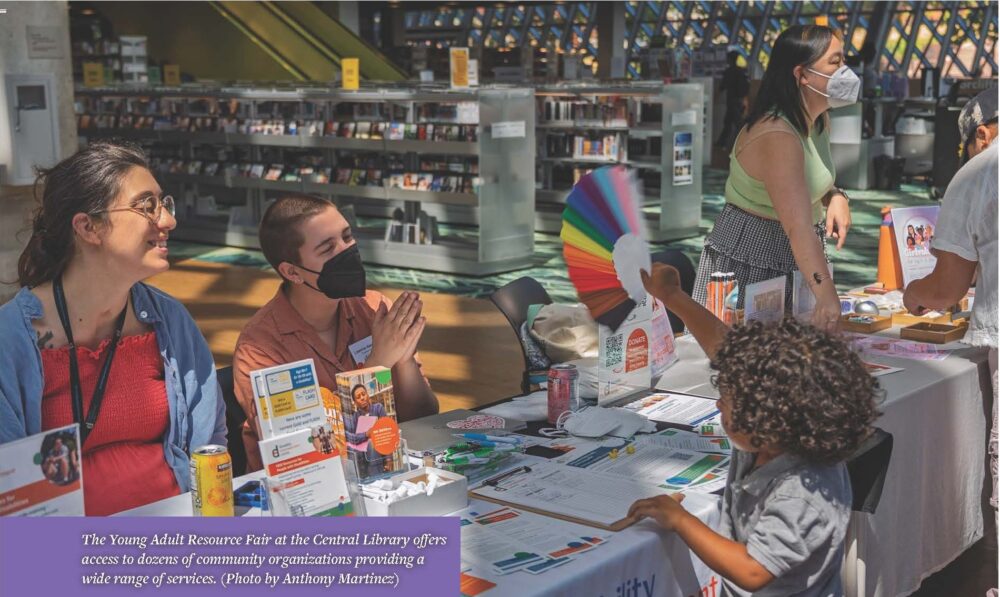
The Seattle Public Library is an essential hub of information. In order to provide free access to all forms of knowledge for everyone, the Library must be responsive to the growing and changing needs of Seattle’s diverse population.
Foundation funding allows the Library to be innovative and flexible. Examples from around the branches demonstrate the value of responding to patron feedback with new resources and services.
Ensuring language access for all readers
Seattle is home to a growing number of Portuguese-speaking immigrants and refugees, mostly from Angola. However, the Library did not offer a dedicated Portuguese book collection. SPL heard increasing feedback from patrons and partner organizations about the lack of reading options for this community. Last year, a new investment launched a collection of 353 Portuguese books for children, teens, and adults. These titles now form the 19th language in the World Language Collection, available at the Central Library and digitally.
“I saw a girl who is usually shy step up to be captain of a team,”
said a school librarian of the Global Reading Challenge.
“The team looked to her for guidance on what to read and how to study.
It has shifted the way she sees herself in her classroom and among her peers.”
Engaging students with books and art
Youth and families living in Yesler Terrace were seeking more ways to engage with art and reading outside of school. In response, the Library worked with local artists of color to develop a four-week program series with Seattle Housing Authority, titled “Academic Adventures.” Programs were free and held on site at Yesler Terrace to reduce barriers to participation.In addition to hands-on arts training, SPL provided responsive read-aloud books, visits from children’s librarians, and activities and games for students impacted by educational inequities. Across Seattle, similar programs for school-age children engaged 730 families and provided 850 books for students to take home for their own collections.
“This is an absolutely necessary tool for me being able to read,”
said a patron of one of the Mobile Services team’s retirement home lobby stops.
“The services provide my only source for books now that I’m unable to get to the Library.
Indeed, a mental and emotional lifesaver!”
Decoding technology for older adults
The Library is committed to digital literacy. For many older patrons, that means understanding how to use and interpret new technologies. In response to this need, SPL focused much of its 2025 older adult programming on tech education.The AI Safety Awareness Project offered free courses on artificial intelligence. Classes with Teens Who Care provided intergenerational tutoring. Kin On, an organization for Asian elders, held Chinese-language tech workshops at the Beacon Hill Branch. Overall, the Library increased its offerings for older adults to 123 programs in 10 languages at more than 40 locations.
Building teen skills through service
Service learning placements help teenagers boost college applications and build job skills. But opportunities are often limited, especially for young people from underserved communities. To address this need, the Library more than doubled the number of service learning options for high school students.
Teens received stipends to work on a range of projects that also address community needs at five branches. One group researched local queer history at the Capitol Hill Branch. Another developed and marketed programs for K-5 students in Rainier Beach. At the Southwest Branch, students organized teen trivia. 100 percent of participants reported increased skills in time management, project planning, and teamwork.
“Your visits are always a refreshing time, coupled with a new
crop of literature to read and enjoy,” said one women’s shelter partner
of the Library’s Community Engagement team. “Having library books brought into the shelter
allows an outlet for individuals who are otherwise closed in.”
Welcoming patrons with new tools
The Library Equal Access Program (LEAP) seeks to expand access to books and programs for people with disabilities. For example, LEAP often receives requests from people who want to learn to read braille. Assistive technology helps meet that need.Last year LEAP acquired a new electronic braille learning device that teaches through a gamified approach. It incorporates the many ways that people interact with braille—sight reading, tactile reading, typing, and using a stylus—into one machine.
Other new devices include an automatic page turner that lets users attach book pages to arms operated by a wireless pedal, and a high-resolution video magnifier that offers text-to-speech for books. One patron expressed his appreciation for the latter device, which allows him to hear printed materials in his native language.
Your gift to the Foundation supports enriching experiences for people from all backgrounds at the library. Give today to invite more families to read and discover at the library, and read the rest of our 2025 Annual Report on Donor Impact.