

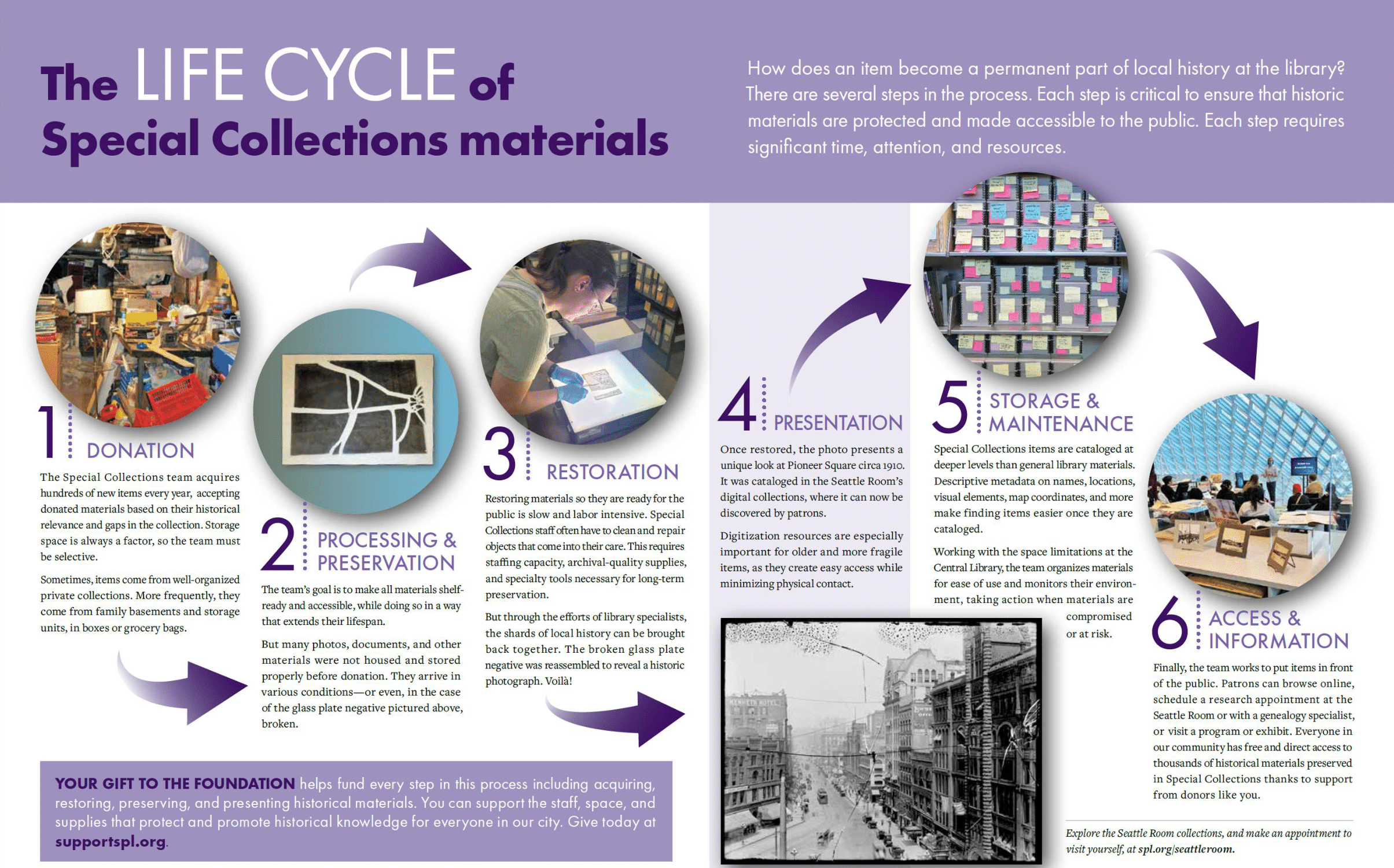
How the library preserves and promotes history
There are more than 100,000 items in The Seattle Public Library’s Special Collections. The Hugh and Jane Ferguson Seattle Room, on Level 10 of the Central Library, houses extensive collections of photographs, postcards, city documents, news articles, and maps. There are oral histories from Seattle residents, menus from notable restaurants, yearbooks from Seattle schools, works by local artists, and more unique ephemera.
Elsewhere, the library holds the largest primary genealogical resource in the state and one of the largest collections of African American literature and history on the West Coast. These collections are available and accessible to anyone—for free, and forever—thanks to the library’s stewardship. The preservation of history is a core part of the library’s mission. Free access to historical knowledge, particularly the stories of traditionally excluded people and cultures, is essential for an educated and inclusive society.
What does it take to build, maintain, and showcase these collections? What do they provide for our community?
Below, we examine the preservation process, challenges, and impacts—and why your support is so critical to protecting and expanding historical knowledge.
From shelves to stories: Library collections inspire local creativity
The priceless historical information found in Special Collections is not just contained inside the physical and digital walls of the library.
Seattle-area writers have long relied on the library to provide key details and discoveries that inform and deepen the stories they tell. This historical information is then disseminated across our community and beyond in the novels, nonfiction books, articles, screenplays, podcasts, and other media produced by library patrons.
Writers frequently make appointments in the Seattle Room, scour digital databases, or immerse themselves in the library stacks as they research and refine their latest works.
“It’s invaluable,” Rosemary Jones said of Special Collections. She is a Seattle author who writes for Arkham Horror, a series of spooky novels based on card and board games. The series is set in the 1920s, and Jones regularly uses the newspaper databases available through the library for research into period details.
“When you write historical fiction, even fiction with tentacled creatures slithering through it, the little details revealed by newspaper stories of the time help add color and verisimilitude,” she said. “A lot of history is lost unless you are willing to go back to the original sources.”
Hunting through history was also important to Shaun Scott, who represents the 43rd District in the Washington State Legislature. Rep. Scott is the author of Heartbreak City: Seattle Sports and the Unmet Promise of Urban Progress. The book emphasizes the meaning of sports to marginalized communities. He pointed to a specific book he found in the Seattle Room, a record of early Black baseball teams called Sunday Afternoons at Garfield Park, as emblematic of how collecting often-overlooked stories helps illustrate the true depth and diversity of history.
“The beach is composed mostly of grains of sand, and I think that history works in the same way,” Rep. Scott said. “You can get a very rich panoramic picture if you’re willing to delve into the pixels. And that’s what the archival storehouse at the library helped me do.”
Karen Treiger approached research from a more personal angle while working on her book Standing on the Crack: The Legacy of Five Jewish Families from Seattle’s Vibrant Gilded Age. She typed a family surname into Special Collections’ online search tool and immediately found a history of Seattle’s first department store.
“My jaw dropped, and I got myself down to the library the next day.” Treiger said. The Seattle Room staff directed her to a one-of-a-kind manuscript chronicling the mercantile business of her great-great grandfather. “I couldn’t believe my good fortune.”
The manuscript, and many other resources Treiger found in her research, were indispensable to her book. Thomas Kohnstamm, author of the 2025 novel Supersonic, said the same about his experience with library collections, spaces, and staff. He wrote much of the book at his local Lake City Branch, and accessed archival newspapers, maps, and planning documents to better understand how the city’s neighborhoods evolved.
“I read widely from lesser-known books and local histories that deepened my sense of place,” said Kohnstamm, whose novel is a multigenerational story of one Seattle neighborhood. “Having access to those materials—and to expert librarians who know how to navigate them—was essential.”
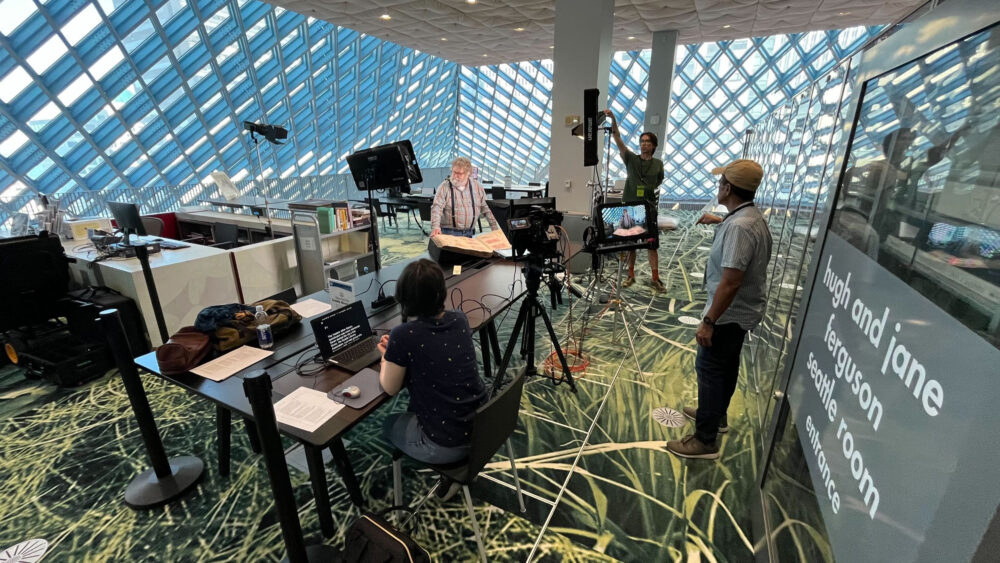
Journalist and historian Knute Berger has extensive experience with Special Collections. Now the host of the history show Mossback’s Northwest, Berger turned to the library for an episode that aired in November on Cascade PBS. He is pictured filming the episode in the Seattle Room at left (photo courtesy of Cascade PBS). There he located a ledger from 1889 detailing the first 10 books provided at one of the first iterations of the public library.
Materials like that, Berger said, provide a snapshot of what residents were reading and what they cared about at an early stage of the city’s history. But more broadly, he argued that the resources in the Seattle Room have become even more valuable in the age of artificial intelligence and widespread misinformation.
“It’s important to preserve and protect photographs and other records so that we have a record of the truth,” Berger said. “As these things get manipulated over time, there’s a source we can go back to and say, well, here’s what really happened or here’s what we know. I think it’s hugely important in terms of giving us a reality base.”
Other writers echoed Berger’s sentiments about the value of historical knowledge for our society and democracy.
“Beyond research, the library offers something rarer: a true public space where knowledge, history, and imagination are shared without gatekeeping, financial or otherwise,” Kohnstamm said. “That openness allows writers (and Seattleites in general) to better understand where we come from and, perhaps, where we’re going.”
“The library is what it looks like to water democracy right at the root,” said Rep. Scott. “Continued support for it is going to mean the world not just for people today, but forever.”
Explore your family’s history with expanded genealogy programs
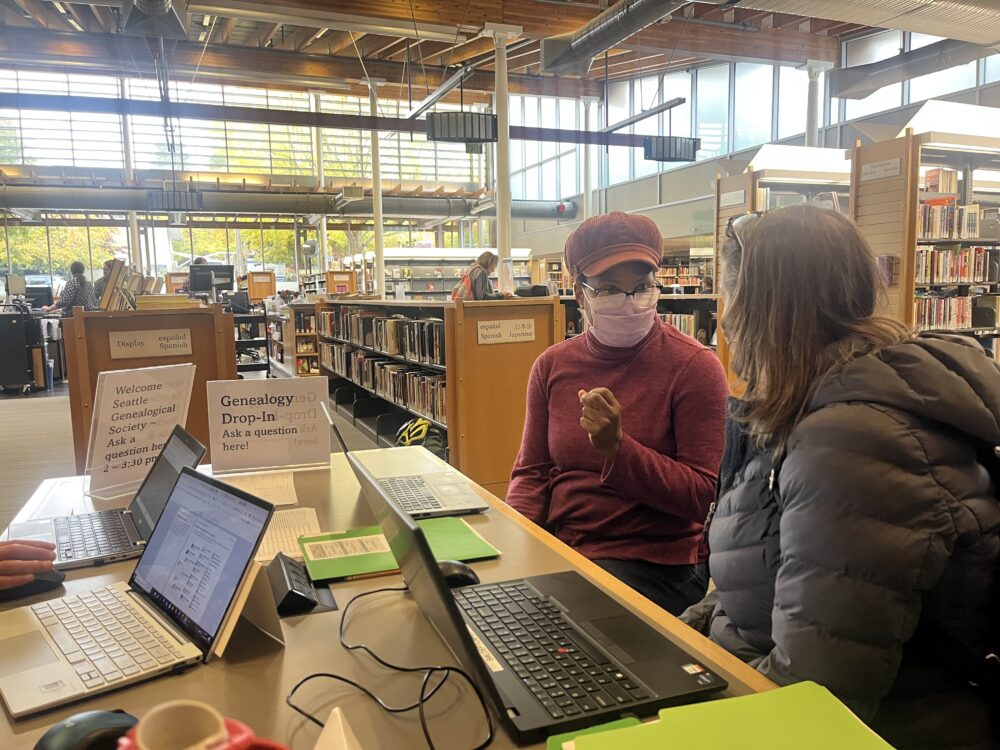
Before Sonia’s grandmother passed away, she passed along a host of family stories that Sonia has spent years researching. She has found marriage records, newspaper articles, and other documents that provide conflicting information—and has run into repeated brick walls, especially regarding her ancestors who were enslaved.
Sonia knew she needed some assistance with her research to uncover the truth. “I’m just trying to look everywhere I can to find more information,” she said.
Then she saw a poster at the Ballard Branch promoting a new free program with the Seattle Genealogical Society (SGS). Drop-in sessions with volunteers help patrons organize their family trees, focus their research, and find the right sources of genealogical information.
(Pictured: Sonia (center) speaks with SGS volunteer Jenny (right) at the Ballard Branch.)
The program also supplements and refers people toward the genealogy resources at SPL. As part of Special Collections, patrons have access to a treasure trove of books, newspapers, records, microfilm, and online resources including free use of Ancestry.com and other family heritage sites. Patrons can also make free one-on-one appointments with specialized genealogy librarians.
The partnership with SGS expands this assistance into the community. Monthly sessions are being held at the Ballard, Magnolia, and Northeast branches until March.
Sessions serve people interested in genealogy at any level. At Ballard one afternoon in October, SGS volunteers Betsey and Jenny met with a steady stream of interested patrons. Some were experienced researchers like Sonia. Others were like Bob, who arrived with a binder full of family immigration records that his parents collected decades ago, wondering what to do next.
“Many people start out with paper,” said Betsey. “And then they realize that they need more resources and more organization.”
Experts like Betsey and Jenny have plenty of suggested tools to streamline information and tricks to uncover hidden details. “You sometimes have to think outside the box a little bit,” said Jenny. She worked with one Ballard patron to locate a Revolutionary War service record he had been unable to find—and in the process discovered that she and the patron shared a distant ancestor from the Mayflower.
“Genealogy research is an act of discovery that can be really exciting,” said SPL genealogy librarian Mahina Oshie. “Researching our past humanizes history and can show us how interconnected we actually are.”
What can I do with my stuff?
Many people come to the Seattle Room desk with offers to donate materials. While the library would love to accept all donations, SPL has limited storage space and the small Special Collections team can only process, preserve, and catalog a fraction of the materials they are offered annually.
If you want to learn more about making a physical donation to Special Collections, please get in touch at specialcollections [at] spl [dot] org.
The most pressing need for Special Collections is flexible funding to support acquisition of rare materials, specialized library equipment, and professional archivist supplies. You can provide essential funding for this work by making a gift here.
Friends of The Seattle Public Library
If you are looking to donate books, consider the Friends! Our partner organization accepts gently-used adult, children’s, and textbooks in any language, for resale or for distribution throughout the community. You can donate books at the FriendShop at the Central Library, at their used bookshop in Georgetown, or via Collins Books. Learn more about book donations to the Friends.
Other collections
Historical materials are also accepted by the Museum of History & Industry (MOHAI), the University of Washington Libraries Special Collections, the Washington State Historical Society, and the Washington State Library, among others.
Thank you for supporting the preservation and promotion of historical knowledge!